Wednesday, September 26, 2007

Baseball

I haven't written much about baseball, but it promises to dominate this weekend. I love the fact that the Phillies could finish anywhere from 3rd in the Wild Card race to having the best record in the National League. I've never seen anything like it.

Here's a quote from an article on mlb.com

The National League West leaders -- by the slimmest of margins -- emerged as the big winners on Flip Friday, as Major League Baseball conducted a series of coin flips by telephone conference to determine sites for potential one-game playoffs to resolve ties at the end of regular-season play.

A total of 28 coin flips were required to account for all possible two-team ties -- for either division titles or the leagues' respective Wild Card races. Easily the most volatile league is the National, which thus hogged 25 of the 28 flips.


Tuesday, September 25, 2007

I'm Riding in the MS150 Bike Tour This Weekend

If you want to sponsor me,

Click here to visit my personal page.
If the text above does not appear as a clickable link, you can visit the web address:
http://www.nationalmssociety.org/site/TR?px=1767910&pg=personal&fr_id=2750&s_tafId=4211

Back To School Night

Why is it called that? It's not just this school, lots of schools call it the same thing. I'm presuming it isn't called that because the teachers have to come back to school after the actual school day. At least in my house, back to school night is the night before school starts for the kids. So I guess the idea is that it's like parents coming back to school after all these years out in the real world. That's sort of sweet, so I guess that's the thing to call it.

This reminds me of a passage from one of the Winnie the Pooh books, where Pooh is asking Owl how to write a letter. Owl says, "Well, Pooh, the customary procedure in this case is as follows." Pooh replies, "What does Crustamoney Proseedcake mean?" Owl explains, "It means the Thing To Do." and Pooh says humbly, "As long as it means that, I don't mind."

Parents Night, as I'm wont to call it, is fun for me. It's a nice chance to meet people and reconnect, sometimes in unexpected ways, like finding out that one of my students went to preschool with my younger daughter and I served on the school's board with his mother for 2 years.
Another Short School Week

I don't know about anybody else, but I'm totally disoriented by this schedule. I never have any idea what day of the week it is or what I'm supposed to be doing tomorrow. I can understand the attraction of the Jewish rituals, which I've never really done. It provides a rhythm and structure that I can imagine would be comforting.

To add to my general haziness, I gave tests in all of my classes today. This means that by the end of the day I'm both exhausted by the general stress of testing and bored to tears by not doing anything. Every time I try to start something during a test, something interrupts me. I think in the nearly 3 hours I was sitting there I completed one page of a lesson plan for one class, and graded 5 tests. Not what I'd consider a stellar output, but it's not like I can talk on the phone or curl up with a good book or nap or anything. I miss the give and take of class.

Sunday, September 23, 2007

Review

I'm giving tests in all of my classes on Tuesday, so Monday is review day. A review is a time to ask yourself, what is it exactly that we're doing? I find this a useful question to ask ones self as often as possible. It certainly was my guiding principle when I was managing a business project. Whenever things started to get crazy (and in advertising, things ALWAYS have the potential to get crazy) I always saw my job as boss being to stop everyone and say, "What is it that we're trying to accomplish?" This question has the almost magical effect of getting everybody thinking in the same direction. Or at least makes turf wars and nitpicking seem irrelevant.

So it seems sort of dangerous to ask that question in a math class, where the second most-asked question after, "Can I go to the bathroom?" is "What am I ever going to use this for?" But that's what makes asking it so necessary. If you can't gain a sense of perspective and meaning along with definitions and skills, why bother? I know that's asking a lot of a kid, but I feel obliged to at least ask. I'm not expecting an epiphany, but maybe a glimmer of insight.

So why learn the math? Because math is simpler than life, and math can be used to simulate all kinds of things that happen in life, except with answers. All we're doing now is creating a toolbox that can help us, well, sometime, for something. I can't really say what, because life is more complicated than math, and not only aren't there a lot of definite answers, it's also hard to know what questions to ask. The more tools you know how to use, the better the shot you have at asking and answering important questions, just like searching for meaning in a passage in history or English or Tanach can teach something about how to ask your own questions.

Well, that got heavy all of a sudden. I guess Yom Kippur will do that for a guy.

Wednesday, September 19, 2007

Screen Gems

I've been thinking about movies today for a couple of reasons. First of all, I'm working my way through the original Star Wars Trilogy, which is now called episodes 4, 5 and 6. If you didn't realize, these are the originals of the series and much much much better than episodes 1-3. The next couple of paragraphs might be enjoyable only to those who know these movies.

I actually saw the first Star Wars movie in 1977 in Salt Lake City. I was driving across the country with a couple of my college friends and it had just come out. You can't imagine what a huge deal it was. Everything gets so hyped these days that it's hard to separate the spectacular from the merely noisy, but this was the first big, special effects sci-fi movie of the digital age. Most of the stuff you see now was invented for that movie or is a direct descendant. The movie was just called Star Wars back then.

I'm in the middle of The Empire Strikes Back, considered by most to be the "best" of the 3. It's pretty dark, but it has lots of witty banter between Han Solo and Princess Leia, and Luke Skywalker's Jedi training with Yoda. One of the things that I always liked about this series was the concept of "The Force," which is the cumulative power of all the living things in the universe. I've never been a believer in the "old man in the sky" version of God, and the Force is the thing that comes closest to what I do believe. That said, the pseudo-religious claptrap in some of the scenes is almost laughably awful in a campy kind of way. For example, after Yoda levitates the space ship up out of the swamp after Luke can't do it, Luke stairs slack-jawed and says, "I don't believe it." and Yoda says, "That is why you fail."

The other movie thing is that I had part of a line from a movie stuck in my head today, kind of the way you get a few lines from a song stuck in your head. The problem was that I couldn't place it. The line was "You've got an overdeveloped sense of (don't remember). It's going to get you in trouble some day." It took quite a bit of discussion before we remembered it was from The Princess Bride. The six-fingered man says it to Inigo Montoya right before the sword fight scene. The actual line is "You've got an overdeveloped sense of vengeance. It's going to get you into trouble some day." This is funny because you already think Inigo is dying, which of course isn't funny at all.

Sunday, September 16, 2007

Holiday Weekend

Didn't get around to writing much this weekend, but I did want to note a couple of things.

I don't know if any of you were at Beth Am, but on the morning of the first day the hagbah guy almost dropped the Torah, twice. Never seen that before. You really have to be right-handed to do that job on Rosh Hashana.

I'm riding in the MS 150 bike tour again this year, this time with my daughter Celia, who is now training up to 17 miles (we're doing 30 together).

While training by myself on Wednesday, I started along the Schuylkill bike path and as I passed Conshohocken, I saw a sign for the "Mid-County Trail." That sounded nice, so I detoured onto it and took a lovely ride through the woods for a half mile or so, with a nice stream alongside the path. Then the woods cleared on one side and the stream ran through a field. Finally, I saw some bright and festive colors through the trees. I came around the bend and saw...the Ikea parking lot. The trail continued past Ikea and the Metroplex, before ending, not at Barnes and Noble/Starbucks like it ought to, but at an underpass where the entire trail is suddenly surrounded by a 10 foot tall cyclone fence. I was a bit confused, but then I saw to one side a small yellow sign that said, "Trail Ends." This is what biking in the suburbs is all about.

Friday, September 14, 2007

Happy New Year

I'll not go into the appropriateness of blogging on Rosh Hashanah now, but I grew up reform and it'll always be a one day holiday to me, even though I often go to shul on the 2nd day. Just one of those little contradictions that make life special.

Just in case someone's stumbled onto this blog hoping for advice, I'll dispense some from time to time. This will include an ongoing series on "How to harmlessly irritate your parents with almost no effort." Today's entry comes courtesy of one of my daughters.

When you come home from camp, put all of your batteries into one big zipper lock plastic bag. When your parents ask you "Are these used or new?" answer, "I don't know."

Monday, September 10, 2007

Hot and sticky

No, I don't have any joke to go with that. It was pretty exciting, though, not knowing if the room you were walking into was 72 degrees and frigid or 91 degrees with air so thick you barely see through it. There's a kind of very large worm that lives at the bottom of the ocean, feeding off of the nutrients in the water flowing out of the vents that shoot hot water out from the center of the earth. The head of the worm lives at 160 degree water and its tail, which is a few feet away from the vents, is in 40 degree water. I'm not making this up, by the way. People (well, biologists anyway) marvel at its ability to thrive in such different physical states, and I marvel at our ability to get a day's work in together when the conditions are, let's say, not ideal.

I saw this today and wanted to share it. Stick with it for at least 2 minutes. I guess it's the same band that did "Technologic," a house favorite here.


Okay, gotta go read "The Fall of the House of Usher" by Poe so I can try to help my daughter do her English homework. I've read of few stories in this Poe unit, and I now don't hate Poe as much as I did when I read him in high school.

Saturday, September 08, 2007

First couple of school days

School started for teachers on Tuesday, but the students returned on Thursday. It's always a little overwhelming at the beginning, remembering how to stand in front of a bunch of kids and talk about math for 40 minutes and get them to listen. It's fun once you get into it, but it always takes a bit to get in a rhythm, especially when there are only 10 school days in September (not that I'm complaining).

I'm teaching Algebra 3/Trigonometry, Honors Elementary Functions, and two sections of Algebra 1, Part 2. It's a nice, well-rounded schedule and I have one day when I'm finished at lunch time.

Before my wedding, somebody gave Ronnie and I a great piece of advice. They said, the whole experience is too overwhelming to retain, so try to pick a few special moments to focus on and remember. The start of school isn't quite that extreme, but here are a few things that stick with me.

  • A group of 6th grade girls standing by the stairs, one of them says "And they're always saying 'You're so cute!' " and the others all laughing.
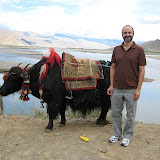
  • Finding out that one of my former students posted a picture of me standing next to a yak in Tibet on his Facebook- my first time appearing on Facebook I believe. And yes it's a real picture and no, I don't really want to see the comments. I should say though that once I realized I was going to look like a tourist no matter what I did, I decided to go whole hog. I even bought a Beijing Olympics baseball cap.
  • Could it be any hotter in Room 20? Room 21 was chilly by comparison.
  • Students coming for homework help on the first day.
  • Seeing the seniors, nearly all of whom I've taught and some of whom I'm working with for the 3rd time.
  • Walking up Old Lancaster towards Montgomery I see them putting up a sign point the direction to the train station and the fire house. I think, who cares where the fire house is? I only care if the firemen know where it is. When you have a fire, do you start looking for a nearby firehouse? What they need is a sign that says Hymies to the left, Murrays and Starbucks to the right.
  • Noticing how small and, well, cute the 6th graders are.
Hope everyone has some special memories. See you all on Monday.

Monday, September 03, 2007

It's Time To Start

It's Monday evening of Labor Day weekend and we teachers toddle on back to school tomorrow. It's kind of cool how I'm so looking forward to the end of the school year and then find myself looking forward to the beginning as well. This is going to be an interesting year at HAFKA (the Hebrew Academy Formerly Known as Akiba). I like the sound of this. It even sounds Jewish. Of course, it's patently disrespectful and I'm sure that at some point someone will make me stop calling it that, but for the moment that's my name for the school.

I'll be blogging on general topics and some things specific to individual classes as the year goes on. I'll label the entries so you can search for whatever topics you're interested in. If you want to hear about my trip to China, feel free to scroll down and/or look in the archives. I just re-read it and it's actually pretty good (I think).

I welcome comments. This blog has a moderated comment section, so don't worry about inappropriate content.

Welcome back everyone!

Thursday, July 26, 2007

Real Life and Movies

It's nice to be home, though I do enjoy traveling. We go up to Lake Placid in a couple of weeks, which is always my favorite part of the summer, if not the entire year.

Our daughter Celia was sleeping over with a friend last night, so we went to the movies. We saw Joshua, which had gotten an excellent review in the Inquirer and sounded intense and interesting. Ugh. Obvious, and so manipulative (you name it, baby in jeopardy, Hitchcock-style music, camera angles designed to spook you, angelic-looking weird kid) that even the twists were letdowns. We were both disappointed, so we decided to see something else. We tried Black Sheep. Don't know if any of you saw The Toxic Avenger, or any of the Troma Pictures stuff from the 80's, but this had grossness to rival even that. The premise, genetically engineered ferocious sheep, is great, the acting was pretty good and there were some very funny scenes, but you had to get by the carnage and, well, lots of wet, stretchy things. Funny, but not for everyone.

Tuesday, July 17, 2007

We're home

At 10 PM, 26 hours after we left our hotel in Japan, we arrived home. Aside from the length of the trip, nothing remarkable happened. We spent many hours in airport lounges, which was quieter than sitting at the gate, but with fewer shopping opportunities.

Two things about Minneapolis Airport. First, there can't be a better place to clean customs anywhere in the US. We were through no more than 20 minutes after the plane landed (too bad we had a 4 hour layover). Second, they have very high-end vending machines, including an i-Pod machine where you can swipe your credit card and get a Nano and a protective case.

I must also add that the Northwest international service was excellent, but the plane from Minneapolis to Philly was dirty (inside I mean), no pillows of blankets even in first class, awful food, and the shabbiest, noisiest baggage claim wheel I've seen anywhere. I couldn't believe it continued to work for long enough to get the baggage out.

So we're home. Time to dig through the mail, get Celia, re-enter our lives here.

Monday, July 16, 2007

Back in the USA

Sitting in the Minneapolis airport trying to make sure I don't fall asleep and miss the flight out. The trans-Pacific leg was routine, though there was an earthquake while we were still in Tokyo. I think we were on a shuttle bus when it happened, because neither of us felt it, and we've both been through earthquakes before.

At this point, I just feel numb. It's 3:00 in the morning in China and I wasn't really able to sleep on the plane. The biggest shock of the day was seeing that our erstwhile luggage, originally booked on the American flight with us, was transferred to the Northwest flight and came off the belt quickly in Minneapolis.

Sunday, July 15, 2007

Just One More Thing...

Not that it isn't always the time to quote Columbo, but we got to the airport to find that our flight had been cancelled because the "equipment," as they say, is unavailable. IOW, the incoming flight was cancelled, probably because of the typhoon. The good news is that we can still get on a flight that gets us in today. We need to get home today because Celia comes home from camp tomorrow. The bad news is it's on Northwest, everyone's least preferred airline, and we'll get back a bit later. Around 8 instead of 4:30, and now we have to trust American Airlines to get our baggage over to our flight. Considering the bang up job they did in Chicago on our way over, we're both brimming with confidence. Ronnie is so brimming with confidence that she's pulled two chairs together in the airline club and gone to sleep. These will be our 10th and 11th flights on this trip, and I'd have to say that it's just about enough.

Other things we've had enough of:
  • Hotel lobbies, bathrooms, and exercise rooms
  • Unpacking, including searching for places to put everything
  • Packing
  • Check-in and baggage claim
  • Breakfast buffets and room service
  • Voltage transformers
  • Elevators and escalators
  • Airplane food
  • Itineraries
  • Working hard to make ourselves understood
Think we're ready to be home? I do.
On our way home

We're in Japan now, staying at a hotel near the airport. We have a nice view of the runway and it's pleasant enough.

The trip out of town was sort of exciting. We went to the airport by maglev train. That's magnetic levitation, not magical levitation, as Ronnie said. The train goes to the airport from some area in the middle of a bunch of high rise apartments, which narrows it down to, well, anywhere in the Shanghai metropolitan area. Anyway, it covers 31 km, or around 20 miles, in about 7 and a half minutes. The top speed is 300 mph, though it only holds top speed for about a minute and then it's time to slow down. Looking out the window was kind of like watching that kind of stop action photography, where the flower blooms in 10 seconds or the clouds fly by quickly. They had to delay the flight because the typhoon was passing over Tokyo and they wanted to wait for it to be gone, but because of the winds behind it the flight was only 2/3 the length of the flight in the other direction.

Ronnie and I had a discussion this morning about how we'd describe this trip to friends. "How was China?" "Oh, it was really great!" It's not the kind of trip that you bubble over about. We went to amazing, exotic places and saw things that most people don't get to. The great wall. Tibetan temples and the Himalayas. Clay warriors from BC. A stone forest. A vanishing river. The biggest dam in the world. A city sprouting a new skyscraper every week. Was it fun? Some of it was. It was all interesting. Time for life without a guide and an itinerary. We're not going to gush about this trip, but we'll never forget it either. China is a huge, weird, fundamentally unstable country that doesn't even know what it is or what it wants to be when it grows up. It's a big baby. Now we can sit and watch with a bit more interest and a bit more insight.

Okay, I've summed up 2 or 3 times already, and there may be more to come. In any event, I'll keep writing if anyone's reading.

Saturday, July 14, 2007

One more thing

Our guide here likes to open with a joke.

Q. What kind of man is best for a woman to marry?

A. An archaeologist, because he'll get more interested in her as she gets older.
Last Day In China

We start for home today. Because we flew using frequent flyer miles, our only option for a return itinerary was to fly out this afternoon and spend a night in Tokyo. We're not actually going to venture into the city, which is over an hour and a reported $100 cab ride from the airport, so we'll stay in the town near the airport, which is supposedly charming. I'll have to check to see if it's okay to drink the water there (it's not here, I've had nothing but bottled water for 3 weeks, no ice, and until this hotel, no salad), but I recall that it's okay in Japan. The water in China is famously bad. All the rooms have a kettle to boil water for tea, or in some cases, with a note mentioning that the water is safe to drink after boiling. I've read too much pollution news, though, and I won't touch it.

As I noted a couple of days ago, it's hard to resist the temptation to sum up. I'll offer a few thoughts, though my desire to do so is tempered by a nagging feeling that I have nothing interesting or insightful to offer on China. Here's what I see.

The gap between "New China" and "Old China" is immense, which puts everything out of whack. China has only been a nation in any modern sense since the early 20th century, truly independent since Mao consolidated power in the 1950's, and a part of the world around them since Deng in 1973. That's not even 2 generations removed from the Cultural Revolution, which was such a disaster that people who were part of it won't discuss it. Our guide's parents were sent to the countryside in their late teens, and stayed for almost 10 years. They've never discussed that time with him. I mentioned that it was impressive that Mao released Deng from jail and forgave him after the C.R., which Deng had opposed, and Jack said that Mao had forgiven many people, but that most of them had died in jail, so forgiveness was of limited use.

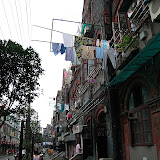
All I'm getting at here is that nothing is settled. There are modern parts of every city, signs of high tech are everywhere, the stores are full of things to buy. But if you look behind the glitz, you see vast numbers of people, even in Shanghai, living in tiny, dilapidated housing, carrying their groceries home from the open air market wrapped in cloths hanging from a big stick over their shoulders. The cars are new, but the trucks are ancient, slow, and clearly without emission controls of even the most rudimentary sort.

The young people are for the most part modern, but it's hard for them to go 2 sentences without mentioning yet another superstition (4 is a bad number, so you have to make sure not to get a license plate with a 4 on it). The oldest generation is completely out of touch with the modern world, and the middle generation, people my age, are scarred by the events of the revolutionary years. The leading edges are world class, but there's no infrastructure, physical or cultural, to back it up, leaving it vulnerable to collapse.

The country seems to be running on its economic engine, but they'll ultimately need more than cheap labor and the unfettered right to dump whatever they want into the air and water. They'll need a transparent system, without the endemic corruption that now exists. They just executed the head of the food and drug administration for taking bribes from the drug companies. The guy was powerful a year ago, so it's not hard to see why there are now all kinds of problems surfacing with Chinese goods. Corruption is at the heart of the system, but the system is run by the Communist Party, which is the ONLY political entity. Can they self-police? Nothing to date would indicate that that's so.

And are they even communist anyway? Ronnie asked me that last night. How are they communist? There's rich and poor, Giorgio Armani a few blocks from hovels (or maybe less than a block- you can't even see where the locals live in much of the city because they live in courtyards behind the storefronts on the street), fancy restaurants and unsanitary little stands selling steamed buns for 8 cents.

Who knows? I'll post again from Japan this evening (morning for you).
More Shanghai

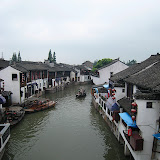
The second day here, we went to an old town about 50 km from the city. Apparently it's about 400 years old, though of course parts were destroyed... It was nice and peaceful, aside from the souvenir stand part of it. We saw a small Buddhist Temple and a very nice Taoist (my favorite) Temple. The town meanders along a canal, and there are lots of pleasant looking old houses and bridges. The town legend is that a famous author jumped off the old bridge and committed suicide 300 years ago, so every year on his birthday the people throw turtles, frogs and goldfish into the canal to keep the evil spirits from eating the revered poet. All the souvenir stands sell turtles and such for this purpose.

Old Town


We went to a postal museum. Turns out the guy who had the Terra Cotta warriors made also started the Chinese postal system, back in 200 BC. He was a busy fellow. We took a very pleasant boat ride on the canal. You know how the Chinese say "Howya doin,?" They say, "Did you eat?" It's not a real question, just a greeting.

Back in town, we ate a large lunch (always, the Chinese insist on offering more food to guests than they could possibly eat, it's a way of showing generosity and prosperity) in a restaurant owned by the wife of the general of the revered Flying Tigers force from the US that helped drive the Japanese out of China in WWII. Lots of pictures of Shanghai in its sultry heyday in the 40's. We visited a plant and animal market (pet animals- birds, fish, dogs, cats, that kind of thing) which was not nearly as horrifying as one might expect. Pet dogs are treasured here, though most of the traditional companions of the emperors were killed you can guess when. Veterinary medicine is a very lucrative business.

This was the night we decided to treat ourselves to a great dinner- the guides always feed us big lunches in famous restaurants, so we usually eat small, calm dinners, usually at the hotel. We're watching the A&E miniseries of Pride and Prejudice on DVD, so that's been our late evening entertainment. Anyway, we love Jean Georges in New York, and he has a restaurant here, so we decided to treat ourselves. I'd e-mailed the concierge before we left and the hotel made the reservation.

When you go out for the evening, you need to have the name and address of where you're going written in Chinese on a piece of paper, since few cab drivers speak English. Our guide had written the address down, but we forgot it in the room, so I asked the concierge and they have a rack of cards for every major site in the city, so he just handed us one, as well as one to get back to the hotel, which even has a little map on it. Cabs are ridiculously cheap in Shanghai. For the 15 minute ride to the restaurant the fare was $2.00.

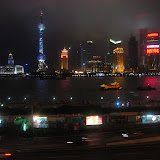
The restaurant is on the Bund, in a pretty old building. The meal was wonderful. We'd heard that the manager had been fired recently because Sharon Stone complained about the white wine when she was there 2 weeks ago. I'm happy for Sharon Stone that the Chinese still care about her. We had no problems, but just to make sure I got red wine. The view out the window was across the river to the area with all the cool new skyscrapers, and there were lots of lit up boats on the river and kites flying over the riverside walkway. All very cool.
Bund at Night


So here's my great idea for souvenirs that I'm not going to be able to do. Everywhere you go, if you're a tourist you're besieged by people trying to sell you fake Rolex watches. According to our guide, they don't work at all, but you can buy them about 10 for $1.25. I wanted to buy a box of 100 and give one to each of my students in the fall, but I was told that US Customs isn't fond of counterfeit items and that I'd be unlikely to get them home. Oh well. And I even could have kept them in the fake Louis Vuitton bag I got from the same vendor.

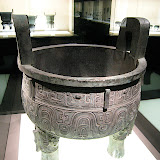
Our final day here, we started at the Shanghai Museum. We resisted going to museums throughout this trip. Is there really something in the Shanghai Museum that there's not more of at the Met in New York? The one thing that interested me was the exhibit of Bronze Age artifacts. I'm not sure I'd ever seen anything from the Bronze Age (except like dinosaur skeletons and fossils- I mean man made stuff). I guess the King Tut stuff was Bronze Age, but that's all.

So I thought we'd pop in, see a few odd fragments, then leave. Turns out they have hundreds of elaborate pieces, with intricate and beautiful designs, going back to the 21st century BC. Amazing considering the world had only been created pretty recently at that point. The skill and design sense blew me away. They had swords and bells and steamers (with slots cut in the bottom!) and many many vessels for wine. I like these people. So we spent well over an hour in that one gallery and then left.

Shanghai Museum


We then visited the Jewish area. Shanghai was one of the few places that would accept Jews trying to escape the Holocaust, and there was a pretty sizable community here. We saw the street that was the center of Jewish life in the 40's, the park where they hung out, and the synagogue, which is under extensive renovation.

Jewish Quarter


After lunch, in a restaurant where numerous heads of state have eaten (pictures of Clinton and Castro, though not together), we walked through a shopping mall, and then to a basement gallery housing one of the most complete sets in existence of propaganda posters from the early days of Mao until Deng Xiaoping outlawed them in the mid 1970's. Amazing stuff- no pictures allowed, unfortunately. Lots of pictures of US imperialists being crushed by powerful and resolute Chinese peasants. Of course even the Chinese admit the Cultural Revolution was a big mistake, but the artwork was marvelous. I was in Russia in 1977, during the Cold War, and there were propaganda billboards everywhere, but these were much more stirring.

Finally we visited a local supermarket, a favorite activity of mine when we travel. I could have spent hours there, but we're leaving tomorrow and need to pack, so back to the hotel we went.

Friday, July 13, 2007

Thinking about China

Much as I'd like to resist the temptation to sum up and draw conclusions, here's my first thought. China is a system that is out of equilibrium. In fact it's far out of equilibrium in many different ways. I don't remember much about science, but I do remember that a system out of equilibrium is not a stable system.

I'll elaborate later. Off to work out now.
Shanghai

What a cool city! We our guide, whose card reads "Jack Robinson," is a huge sports fan and takes his profession very seriously, in that he wants to be the absolute best guide possible. His English is excellent and he is very knowledgeable about the city.

We're staying at the Four Seasons Hotel, which is maybe the nicest hotel I've ever stayed in. The room is huge and beautiful, the service is terrific and the health club is to die for.

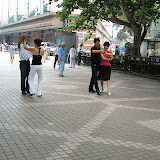
The city, which has 18+ million inhabitants, is like East meets West. By most appearances, it looks like a European city that has been abruptly populated by the Chinese. The building style is different from anywhere else in China, but would be unremarkable in France or Holland. But all the signs are in Chinese (and English). We started our tour with a visit to a park, where men were flying kites, old people were doing Tai Chi, younger people were ballroom dancing (tango, fox trot, that kind of thing), and others were loudly singing songs in large groups, with a header up by an easel holding the lyrics. Jack said that they are songs praising the Communist Party, but he also mentioned that most of the old people had now left the part to stand outside the nearby stock exchange and follow their investments. So there you go. China in a nutshell.

We walked around the area called the French Concession. When China lost the Opium Wars, which as far as I can tell were about the Western countries wanting to be able to sell opium in China in an unfettered manner. The resulting treaty gave control of pieces of Shanghai to the British, French, Japanese and Americans (who ceded their part to the British when WWI started). It's this kind of history that helps Shanghai look the way it does. After walking through the residential neighborhood and shopping in some nice boutiques we went to an area called The Bund, a well-known street along the river. The buildings are about 30 early 20th century beauties in a row along a curved street. THey all look like banks, and I guess many of them are, though some have stores like Armani or Hugo Boss in the lobby. Apparently it's special at night when it's all lit up.

We then went across the river to the financial center, where most of the tallest buildings are being built. The Grand Hyatt has its lobby on the 56th floor of an 87 story building, and a fantastic atrium. After lunch, we went to the "Old City." It's called that, but it was all rebuilt in the 1980s because...okay, you should know this by now, the original was destroyed during the Cultural Revolution. Apparently it was actually the orignal commercial hub, but it's just a bunch of cute souvenir shops now. In its midst, however, is the Yu Garden, noted by our guide as one of the 3 things one must see when in Shanghai. It is a beautiful thing. Even though it's pretty small and a bit crowded (apparently it's shoulder to shoulder on weekends) it's beautiful and peaceful. This whole feng shui thing has something to it, even if part of the idea is to allow dragons to fly through the space easily.

That evening, we saw the Shanghai Acrobats. It was an impressive show, but Cirque de Soliel has spoiled the drama of this sort of thing.

Shanghai 1
Three Gorges Dam

This is odd, trailing what we've been actually doing by a couple of days, but I'm endeavoring to catch up.

We visited the dam after the cruise ended. Even pictures can't give a sense for how mammoth this thing is. The Yangtze is a huge river, and to put a 600 foot tall dam in it is audacious at the very least. The Chinese government has talked about damming the river for a century. The area upstream from the dam has had catastrophic floods on a regular basis throughout history, and navigation through the gorges was famously treacherous. The navigation problems have certainly been solved, though nobody really knows whether the flooding will be eliminated. In any event, they've moved most everyone out of the flood plain, like it or not.

As for the environmental effects, I'm sure the fish are happily engaged learning new living habits, and they also don't really know what's going to happen to the tons of silt that the river carries. The official story is that there are sluices that will allow passage of the silt, but that really seems impossible. I can't imagine it's not going to take constant dredging. Anyway, it's there, like it or not, and it's expected to generate 5% of the power needs of the country, which considering how bad the air is here, should be of some benefit.

I'll post a couple of pictures later, but they can't capture the scale.

After the dam, we visited a sturgeon farm, where they are attempting to keep alive the sturgeon that would normally swim up the Yangtze to spawn. Fish ladders were too expensive, so they've built a hatchery and breeding center where they keep the sturgeon until they can fend for themselves in the ocean. The place is surreal. It could not be dingier if it answered a casting call for dingy spots. The tanks, which look bright and pristine in the introductory video, are algae-covered and dark. I guess they're big enough for the sturgeon to swim around some, but I have no idea. Very odd that they would show such a thing off.

Off then to the airport and on to Shanghai.

Thursday, July 12, 2007

The cruise, continued

We're in Shanghai now, which is an amazingly cool city, but I'd like to wrap up the cruise first.

The second day of the cruise was the most active. We went through the Three Gorges area, which is one of the most scenic places in China. They were very beautiful, especially the second one. Sheer limestone cliffs with cypress trees poking themselves out the side wherever there's some water seeping through. The cliffs rise several hundred feet on both sides. I can only imagine what it looked like when the water was 400 feet shallower and full of rapids and big rocks. We went through a place called "Empty Boat Shoal," which was so shallow and dangerous that everyone and all the cargo had to get off the boat and go by donkey for a mile or so while hundreds of "trackers," guys with poles and bamboo ropes, got down in the river and push and pulled and guided the boats through. A German boat hit a rock and sank, killing 100 people in 1903, causing that section of the river to be closed to traffic for the next 7 years. The government blasted the rocks out with dynamite in the late 40's.

We got off the ship and onto smaller boats to go up one of the tributaries of the Yangtze. Very beautiful up there. Most of the people around there had to be moved because of the dam.

Cruise


So what do I think about going on a cruise? (This is very Chinese style. The guides all tell you about things by asking questions and then answering them- typically, "why is it called this? Because 100o years ago..." Then we say, "Is this original?" and they say, "No the original was destroyed in the Cultural Revolution.") I'm probably not really a cruise person, though if I have a good book and some music I can be pretty contented anywhere. We didn't have to socialize too much, and we did enjoy the company of one of the couples at our table. It's just a bit claustrophobic, and I sometimes can't sit still that much. They had a small workout room, but not really anything adequate. I like the book I'm reading, The Yiddish Policeman's Ball by Michael Chabon, but it's just not quite enough. I'm glad to be in a big city.

Okay, time for a snack and then off to see the Shanghai Acrobats.

Wednesday, July 11, 2007

So two Jews get on a boat in Chong Qing...

I'd have to say that I don't think I've ever felt more foreign than I do here, and I'm saying this as someone who has moments pretty much every day when I stop to check on who I am and what I'm doing here, even in the most familiar of surroundings. I've been in plenty of places where I'm not a local, but this is beyond anything. Before we got on the boat we hadn't seen anyone European-looking for several days, though I guess there was a German family at the hotel in Kunming. The flight, forget about the flight, then entire airport in Kunming was populated by Asians. In any event, the boat had a mix of nationalities, and very few Chinese as passengers. We met Thais, South Africans, Aussies and a few Americans (well, Texans anyway). In Tibet we'd hung out with Americans as much as possible, joining another family for dinner one night and inviting a woman traveling alone to join us another night (wife of Chairman of the board of Brandeis U, as it turned out). Here we had an assigned table, and our company was an Australian couple and an American man and his 10 year-old daughter. Could be much worse.

Let me tell you about what I saw on the Yangtze. First of all, these people will farm ANYWHERE. Almost every steep hillside is terraced with small patches of crops, usually corn. "Look, corn!" has become a running joke, because it seems to get squeezed into every piece of unoccupied land larger than a couple of square meters. Second, most of the upstream damage has already been done. A million people have been relocated to varying size cities featuring the classic apartment building the design that makes every Chinese city at best boring and worst an eyesore. They will go so far as to admit that the older people are not happy about this, about 10% of the relocated people are unhappy, mostly because they have been given insufficient compensation by the government. Finally, the old Yangtze is gone. The water level has already been raised 140 meters, with another 35 to go. Most of what existed by the river is now under water, the river is wide and deep with no rapids.

I'd read about some of the river towns before we came, but none of them exist in their original form. We stopped at on called Fengdu, which was pretty big (half million people), though not at the town itself. We were given a choice of visiting a relocated family or going to something called The Ghost Temple. Although we're about templed out, we went for the ghosts. The ship docked at the site of the old town, which is new just a few foundations left for ships to dock. Everyone's been moved across the river., but the temple is still in place, being on top of the hill. As temples go, this one was pretty cool, though most of it was reconstructed after the Red Guard smashed everything, except for a couple of statues that they were apparently afraid of. There are some scary-looking ghost types, and some impressive looking folks who will make the heaven/hell call for each of us. The guide made a joke of everything, and kept giving us little things we had to do to keep our soul safe, like cross a bridge in an odd number of steps, run up these stairs without breathing, balance on this rock on one foot for 3 seconds, pull a rabbit out of a hat. Well, maybe not the last one.

We left Fengdu and kept moving down the river. One of the problems I have with this kind of activity is that everything revolves around meal times, and even if you don't actually get fat, you feel fat. I'd lost about 5 pounds in Tibet, so I didn't really care, but I get tired of feeling stuffed all the time. Apparently, the food was very restrained as cruises go.

I'll continue with the journey later, but first a diversion to:

Chinese Rules of the Road

1. Any vehicle can and should be passed at any time and on either side, regardless of potential impediments.

2. Honk your horn if you see anything moving or that has the potential to move in front of you.

3. If someone honks at you, ignore it. If you are a pedestrian, do not look up.

4. Turn first, look second, or not at all if someone honks. This applies to left, right and u-turns.

5. Traffic markers, lights, signs and rules are, as they say in Pirates of the Caribbean, not so much a code as guidelines.

6. Anything with wheels may be driven or ridden on any road, but only 2 or 3-wheeled vehicles may be driven on the sidewalk.

Still more to come, I've heard the traffic in Shanghai can be exciting.
Back In Touch

We're in Shanghai now, having arrived a couple of hours ago from Yichang, the home of the Three Gorges Dam and the end of our cruise. We got to tour the dam site today. It's a very big dam, and based on the responses I got to the environmental questions I asked, they have no idea of what the ultimate effects will be. My favorite response? To the question, "What will happen to the fish?" the answer was, to quote, "The fish will have to learn new living habits." Whew, fish are good at that, I think. We also toured a sturgeon farm, for the endangered Chinese sturgeon, which have proven to be not so adept as those other fish at finding new living habits. Anyway, the video had lots of men and women in white coats working on the surgeon problem, so I for one am relieved.

The cruise was interesting. We met some nice people, including an Australian couple who are in the same hotel as us here. I'll elaborate at another time, because it's late and I have lots to say about the cruise.

Before we started the cruise, however, we arrive by air via Chong Qing. As we landed, I said to Ronnie, "Watch, this'll be another city of 6 million people we've never heard of." Well guess again. 10 million? 20 million? Nope. 32 million people. Imagine an area the size of the Northeast, except it's all high rise apartments. Now imagine there are 3 of them. That's what the drive from the airport to the boat was like. Plus add, and I'm not exaggerating, at least 250 more high rises under construction. That's Chong Qing.

On the way to the boat, we were forced to make a stop at the local museum. We found out afterwards that the floods here were so bad that they weren't sure they could dock the boat. Anyway, the museum was, as best as I could tell, a museum of 18th century beds. All from local families. And did I mention that Chong Qing has a nickname? Furnace City. We did eventually make it to the boat and kept our luggage in our possession in spite of the dozens of very helpful people who wanted to carry it for us as we get to the dock.

Much more to come.

Tuesday, July 10, 2007

The 3 Gorges are Gorgeous

Sorry, but I had to get that out of my system. I'm on a very S L O W modem here, so it's just a quick note. I'll be in Shanghai tomorrow evening and will have lots to say then.

The boat has been fine. The scenery is interesting, though I'm getting tired of the guides saying "There used to be something interesting here but now it's under water." Still pretty and dramatic at times. We're waiting to get through the lock at the dam site. They say it will take 3 hours to get through it.

Also, the Chinese are afraid of the number 4, becasue the word for it sounds like the word for "death." Our last hotel had no 4th or 14th floor, and our room was 1615. Yes, that's the one between 1613 and 1616. Good thing there aren't 4 gorges here, or we wouldn't be able to talk about it.

Plenty of pix tomorrow.

Karaoke tonight. Think I'll partake? It'd be a first.

Saturday, July 07, 2007

Terrific Day and an upcoming hiatus (maybe)

This was our one full day in Kunming, and our guide was determined that we make the most of it. I should mention that this is the provincial capital of Yunnan Province, which I'd never even heard of. Turns out it's an attractive (by China standards anyway) city of 5 million, with a pretty urban park with a lake across from our hotel, nice shops and restaurants, and all the advantages that come to a place that's the center of a rich agricultural community and is the closest city in China to Burma, Laos, and Vietnam.

Our guide is a fast-talking twenty-something young woman, who is looking to land an American man, by the way. We decided not to take the freeway to our destination, the Shilin Stone Forest. Taking the local roads took us through terraced hillsides with every manner of fruit and vegetable growing. The soil and the climate ("the city of eternal spring") are great. We stopped twice- first at a silk embroidery business, where we met all the various relatives of the family business, and ordered a piece that they said would take 3-4 months to make. The precision of the work is exceptional, and it seemed like everyone in the factory got involved in the process of our selecting something.

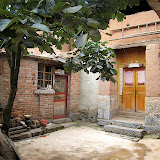
The second stop was a small agricultural village, a mixture of small houses made from bricks made of mud and larger stone and tile homes. Lots of old people and kids, the parents were either in the fields or in the city looking for work. I lack the skill to describe it properly, it's unlike anything I've seen before, so I'll try to post some pictures soon, though those won't capture the smell (earthy would be the most complimentary way I could describe it).

Our destination was a limestone formation that's a national park and a recently named World Heritage site. All kinds of cool formations with little pathways all through it. The place was a little overdeveloped, we kept waiting for "It's a Small World" to start playing, but the rocks are pretty remarkable.

Shilin and village 7/7/07


One of the unique things about this area is that it has a large number of ethnic minorities, which apparently have been expelled from wherever they used to live. Our guide is of the Yi minority, whose girls traditionally learn to do intricate embroidery, and once they know how to do it have a ceremony where all the single girls and guys meet around a bonfire and the girls each bring a heart-shaped embroidered pillow. They select the boy they want and toss the pillow to them. If the boy isn't interested or think the pillow's not good enough he tosses it back and the girl tries someone else or decides to do a new pillow for next time. This seems very cute, and much nicer than the group where the boy bites the girl hard and if she likes him she bites back until they both bleed, and much quicker than the group where if a boy wants to marry a girl he has to work for their parents for 3 years first. Our guide noted that there is rarely divorce in this group because nobody wants to work for 3 more years. She then said she was still working on her pillow, but if she met the right guy she would just throw herself at the boy.

As an aside, while we were on our way to lunch, she mentioned that the Cantonese are noted for not being that picky about what they eat. The two related sayings are "The Cantonese eat everything that moves" and "The only thing with 4 legs that the Cantonese don't eat is the table."

Tomorrow we head to our cruise on the Yangtze River. We're not exactly cruise people, but how else are you going to see the Yangtze? Forced socilaizing is not something that either of us like to do, but I'm sure we'll try the Mah Jong lessons, tai chi classes and whatever else. Didn't notice if they had shuffleboard. We just noticed that the "Captain's Dinner" is jacket and tie. I didn't bring a tie, and unless the captain himself lends me one I'm not wearing one. It's a fancy ship ("Cruise the way Bill Gates did"), so we'll see. The last time we were on a cruise was in Alaska on our honeymoon, which I remember not liking very much, though we did get to see a whale leaping out of the water. If you want to read a good story about a cruise, pick up "A Supposedly Fun Thing I'll Never Do Again," by David Foster Wallace.

I'm not sure how often I'll be able to post from the ship. I think they have Internet access, but I'm not sure exactly how accessible it'll be. We'll be in Shanghai from Thursday to Monday when we head home. We're more than halfway through.

Friday, July 06, 2007

Parting thoughts on Tibet

We left Tibet this morning. We were very ready to leave. Here are the pictures from yesterday's trip

New Album 7/6/07 6:20 AM


We're now in Kunming. We took a brand new plane where the seats were so complicated that they had 13 buttons to control the position, and a 5 minute video showing you how to use them. Way more comfortable than anything I sat on in Tibet.

We had some water yesterday from a store called Wahaha. Made me feel kind of at home.

One thing about Tibet is it seems completely focused on 2 things- Buddhism and yak. Both are impossible to avoid if you want to go outside or eat. It kind of limits their world view, I think. In the book I'm reading, the Dalai Lama notes that the growth of spirituality beyond a certain point basically doomed Tibet as a country able to defend itself. I could certainly see it. There are people walking around, doing usual kinds of stuff, but there's a larger number coursing around and through the temples and monasteries. Our guide said that the younger generation was not so focused on this, but she certainly was, to the point of not being much of a useful guide for any other purpose. I'm actually going to complain to the tour company about it.

Kunming looks like a garden spot in comparison, and in fact it is known as the garden city. The trip here was enlivened by one of the tightest connections I've ever made, thanks to Air China's inability to either (a) check baggage through onto another airline, or (2) get the bags off the plane in less than 30 minutes (just like US Air in Philly!) We had a transfer guide and he ran us all the way to the check-in spot, which we reached 3 minutes before the flight closed.

Thursday, July 05, 2007

A day with pretty much no Buddhas

Hard to go a day without Buddha in Tibet, but we pretty much managed. We're leaving tomorrow and though we don't at all regret having come, we are very ready to leave.

Today we went to a sacred lake, which is about 120 KM from Lhasa. It's called Yamdrok and to get there you have to drive for about 2 hours through and up into the Himalayas. The mountains are incredible, they seem to go on forever and they're not all of the same type. We started collecting rocks, because I started by finding some flaky sedimentary rock, but we found lots of other things, including river rocks, at 15,000 ft above sea level, with no river in sight.

We heard about how beautiful the lake was, which it is, but the place where you view it was crowded, filthy, full of busses belching exhaust and honking their horns (because it's illegal to drive in Tibet without honking you horn every 10 seconds), and aggressive vendors selling all kinds of junk or wanting you to have your picture taken with their yak. I have to admit I did take a picture with the yak.

SO we drove beyond where the busses turn around and got a much nicer view. It's a huge lake, surrounded by mountains, with the snowpeaked mountains in the distance. It's bright blue and smooth as glass. There wasn't a single boat on it for some reason. I heard there was a huge hydroelectric dam around the bend, but we didn't see it.

We ate at a local restaurant which had very good food and the most unbelievably disgusting bathroom I've ever encountered. I didn't take a picture, you'll just have to take my word for it.

Got back to our uncomfortable, but traditionally decorated, hotel room and we're ready to pack. I'll have some final impressions on Tibet and some more pictures tomorrow.

Wednesday, July 04, 2007

2 Days in Tibet

This is not the most fun place I’ve ever been, but it’s “interesting.” It’s certainly one of the most uncomfortable hotel rooms I’ve ever had. But the sights and the overwhelming Buddhist atmosphere are incredible. We’ve visited several shrines and all of them are crawling with pilgrims and older people praying and chanting.

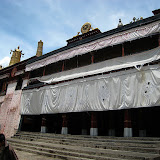
Drepung Monestary


Today I had my health protected at the Horse Head Buddha by sticking the top of my head in an indentation under the Buddha while a monk said a prayer. Then my positive future was ensured by resting my forehead at the end of a stick that reached into the Future Buddha shrine while another monk made a prayer.

We saw the Summer Palace built by the Dalai Lama in 1957, only 2 years before he had to flee. One thing we noticed was that there are dozens of images of Dalai Lamas 1-13, but nowhere will you see the living Dalai Lama, who has been in exile in India since 1959. He’s not real popular with the Chinese government.

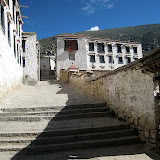
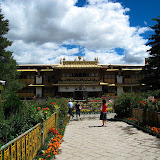
Summer Palace/Street Scenes


After lunch (more yak), we went to the Sera Monestary, originally built as a rival to the Drepung Monestary, which we’d visited in the morning. Sera is small and looked poorer, but has a bit of a tourist attraction in its Debate Courtyard, where 150 monks gather every day from 3-5 PM to debate, discuss, argue, and seemingly trash talk, whatever happens to be on their mind. It’s like a really really large Jewish family dinner, but without the food.

Some of the debates were quiet and serious, while some were loud and raucous, with one standing monk trying to lecture several seated monks, punctuating each point by clapping his hands once loudly and sliding his right hand up his left arm. One monk did a nifty spin move after each clap. He must be the T.O. of the group.

Sera Monestary 7/4/07


Came back to the hotel for a massage that was more enthusiastic than anything else, and now we’re just trying to catch our breath. Then to the Yak Café for dinner- I’ll probably have pizza.
Random notes from the first week in China

I’ve often noticed that vacations are on a continuum from “Interesting” to “Fun.” It’s hard to have both. The Running of the Bulls in Pamplona was both. The rest of our Spain trip was mostly interesting. Most of our Amsterdam/Brussels trip was fun. This trip definitely falls into the interesting category, especially Tibet.

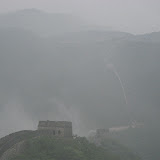
I never said much about the Great Wall. It was raining and we were upset about our luggage and you had to pass through the Great Wall of Souvenir Vendors to get there and back. Vendors know 3 phrases in English, “Hey lady,” “T-shirt 1 dollar,” “Hello souvenir.” Very aggressive. Salespeople in stores are very aggressive too. They hover and suggest things constantly, and have several more suggestions once you say you’re ready to finish and pay.

Anyway, the wall is an incredible sight, up along the top of a mountain range. Why a 20 foot wall on top of a 2000 foot mountain ever occurred to anyone is beyond me, but I guess it was good for shooting arrows at approaching horsemen.

Great Wall/Tea Ceremony 6/30/07


Drove by the 2008 Olympic Complex. The stadium is cool. The facade has interwoven strips of metal and the top is scooped. It looked like a giant bird nest to me, and our guide said that’s what everyone calls it. The swimming venue has a blue façade with a bubble pattern in relief. The Athletes Village looks like every other ugly apartment building in China.

When we left Beijing I wrote in my notes that it was the ugliest city I’d ever seen, but Xi’an was even uglier. The Red Guard destroyed everything historic during the Cultural Revolution and what’s been build since then is square and squat and dilapidated even when it’s brand new. They’ve done the same thing to Lhasa. It’s amazing they left anything to see.

Tuesday, July 03, 2007

Flying blind

For some reason, I am unable to view the blog, though I can edit. Don't know what that means, but I hope the pictures got attached and that something is actually showing up.

Today was our first full day in Tibet, so we saw the two big sights in Lhasa, the Portala Palace and the Johkang Temple. They are not to be believed. The palace is built into a hillside (remember, of course, that the base of the hill is at 14,000 feet) and it was the home of the Dalai Lamas until the current one had to flee in 1959. It has the living quarters, chapels, meeting rooms, tombs, and whatever else going back to the 7th century, although much of it has been rebuilt over the years. They say there are 1000 rooms, but nobody's actually counted. Most of the monestaries were destroyed during the Cultural Revolution, but fortunately the government wanted to use the offices in the palace, so it remained.

The Dalai Lamas are cremated, so the tombs aren't big like some, there are sometimes more than one in a relatively small room, but they are incredibly ornate and beautiful. The tomb of the 5th Dalai Lama is made from 3700 kilograms of gold. Every shrine has incense burning and yak butter candles burning and people bringing their own yak butter to put in the candles and it's completely overwhelming. Every day thousands of people walk around the palace spinning prayer wheels and chanting.

The temple is relatively small, but has also been around since the 7th century, and some of the support timbers are original. As you enter you pass dozens of people prostrating themselves and praying by an exterior shrine, which is flanted by 2 10-foot tall incense burners. The inside has about 20 small shrines and one big central one. Thousands of Buddahs of all different types.

We also bought a carpet and walked around a huge open air market.

Okay, I'm starting to feel a bit woozy again- still not used to the altitude, so here's what I rote but couldn't upoad yesterday:

From yesterday

I'm not sure why I wanted to come to Tibet. I just knew I did. But from the moment we booked the trip I had trepidation about it. Why? Well, a couple of things.

First and foremost, the altitude. We're in the capital, Lhasa, home of the Lhasa Apso dog (no, not really, or maybe it is, I don't know). Lhasa is at 3600m above sea level, which is a shade under 12,000 feet. There's not a lot of oxygen to be had here, and I had a real fear that we'd get here, one of us would get altitude sickness. You can never tell who will or won't get it, and you can feel ill even if you've been before and felt fine. I bought some chocolate, because I remember in the 3rd Harry Potter book that chocolate makes you feel better after the Dementors come, so it ought to work for altitude sickness too.

Second, if you think where you went to summer camp is in the middle of nowhere, you ain't seen nothing. This is not only isolated, it's surrounded by mountains, so even though 99.99% of the land is unused (2.5 million people in an area the size of Europe), the airport is 60km away because that's where it's flat. And to get here from the airport you have to drive though a 2 mile-long tunnel through one of the mountains.

Finally, and least important, there's no place nice to stay. Sorry, but I like to come home to a comfortable room. Doesn't need to be fancy, just clean. I had read vastly varying reports about this hotel, regarded as the best in town. Fortunately, our room seems perfectly clean. Comfort is another matter, but considering where we are, I'll settle for clean.

Our itinerary for the day was simple. Drive from the airport to town, rest in the room for the remainder of the day to get acclimated. Drink lots of water. I had a yak burger for dinner (with cheese!). Tomorrow we go out and see things. I've been reading lots about the history of Tibet. The Chinese position is that Tibet has always been part of China, but there's little in the history to support that. Tibet has only been under the rule of any single entity for a small part of its history, and it certainly wasn't under China. What makes Tibet unique is Buddhism, which they imported from India a long time ago.

I've been trying to understand Tibetan Buddhism, but it's complicated and any kind of Buddhism is hard for a non-Buddhist to understand. For one thing, there's lots of Buddhas, only one of which was a 6th century BC historic figure, as far as I can tell. There have historically been 4 main types of Tibetan Buddhism, which I'm not going to list because they're hard to spell and you won't remember them anyway. The Dalai Lama is from one particular sect, but has often been the leader of up to 3 of them. Some Dalai Lamas, like the present (14th) Dalai Lama, are political leaders as well.

The sects vary mostly in the orthodoxy of their practice, but not exactly like Jewish orthodoxy, because I don't think they all read the same holy books. It seems to be all about attaining enlightenment and how fast you can do it and what you need to do to get there. It's multifaceted, even before you start throwing the varying levels of reincarnation (spirit or body or some combination).

Enough of that. You've never seen anything that looks like this place, and we haven't even seen anything except what's alongside the road on the way here from the airport. The houses are low and plain, but with beautifully decorated doors and windows. Every house has 5 different flags flying from the roof, to connect with the 5 elements of nature, (earth, water, sky, fire and something else). I'll attach some pictures if I can. There's a river running through the valley so there's farming near the river, but it gets very dry very fast as you move away, not that you can get too far away before you hit the mountains. Farm animals running around. The biggest, grandest structures aside from the new police station are the gas stations. I don't know why.

Before Lhasa we were in Xi'an, the ancient capital of China, where the Terra Cotta Warriors are. The other thing I noticed there was the driving. Driving in Beijing was pretty civilized. People were aggressive sometimes, and on country roads there's a lot of passing and honking as you pass, but it's clear that rules are being followed. In Xi'an, there's no such order. For one thing, the left lane is supposedly the passing lane on the expressways, but it's not. The slower cars drive in the left lane and everyone passes them on the right. On a 2 lane road, you have more options, because you can pass on the left or on the shoulder to the right, unless of course there's a bicycle or a 3-wheeled moped truck or a tractor or something else on the shoulder. The only thing for sure is that you honk whenever you drive anywhere near any other conveyance.


So yesterday I mention to Lee, our guide, that driving in China is much more interesting than in the US. He said that actually, they have very strict laws, but you'd never know it. We kind of dropped the subject then, but this morning he asked me if driving was more orderly in the US, and I said yeah, and as I looked up, a motorized bicycle going in the wrong direction passed between us and another car on a traffic circle. I mentioned that nothing like that would ever happen in the US, and Lee said that in China, everyone just want the shortest distance between two points (see, I knew math was handy) and it was too long for the bicycle to go all the way around the traffic circle.

I should also point out that it was raining and the variety of ways bicyclists cover themselves and whatever they have with them is fun to watch. Of course there are lots of people riding holding umbrellas, or with big panchos covering themselves and their cargo (or kid on the back). The worst thing we saw was a kid on the back of a bike with a plastic bag over his head. Don't they read warning labels here?

Sunday, July 01, 2007

Unlike anything I've ever seen

Today we checked our bags with a bit of trepidation and headed off to Xi'an. Easy flight and pickup. We went directly to see the Terra Cotta Warriors, located about 30 miles from the city center.

For those not familiar with the story, a group of farmers were digging a well for their pomegranate orchard and found a few pieces of what were obviously clay figures. Archaeologists did some digging and found that the 3rd Century BC Emperor Qin had created a huge army of clay soldiers to guard his tomb. They've now dug up quite a bit of it. I uploaded a few pictures at

China

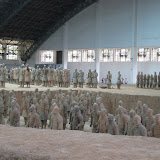
It is one of the most amazing things I've ever seen. There's a pit the size of 2 football fields full of columns of soldiers in full battle gear, horses, chariots, all facing the enemy to the east.

The soldiers are incredibly lifelike. Every face is different. They all look resolute and ready to face whatever may come. By now, most if not all of them are in pieces, either from deliberate looting and destruction or by natural processes, but they've put many of them back together like a bunch of 3d jigsaw puzzles and left a lot of the pieces in place. The cumulative effect is breathtaking.

Tomorrow we're off to Tibet, which is pretty scary because of its remoteness and altitude. Not really sure how we'll feel physically. In any event, when we arrive tomorrow we're supposed to sit around for the rest of the day just getting used to the altitude, so I'll have a chance to catch up on writing about what else we've seen and done.

Saturday, June 30, 2007

The voyage of the luggage

Let me set the scene. We get a call in the morning saying we that they found our luggage and it's still in Chicago. Japan Airlines and American Airlines are blamng each other. We were on our way to the Great Wall (which was and is great, by the way) and it really took the wind out of our sails. I'll write more about the wall later, but unfortunately this whole trip has turned into the saga of the luggage. After the Great Wall we took a tour of the traditional areas of Beijing, which were not nearly as interesting as that sounds. It was raining the whole day and kind of depressing.

Then we went to the tea market, and had an amazing visit with a tea vendor who sampled green tea, oolong tea, aged black tea, another kind of aged and fermented oolong tea and tea made from baby chrysanthemum flowers. Best moment we've had here. Then we blew off a special dinner in a top restaurant and started scrambling to buy things, since we're about to go places where you basically can't buy anything. Got underwear, shampoo, toothpaste, that kind of stuff, at a supermarket, then to a mall to buy pants, t-shirts, and way too many other things. We got some, but not really enough. It was 9:45, we were both exhausted, we had both been missing our prescription medications for several days and weren't sure about the wisdom of proceeding.

So we headed back to the hotel to decide whether or not to carry on or to just chuck it and go home. I'd had this voice in the back of my head saying "this is a disaster, let's just go home," and so had Ronnie. We walked in the hotel room at 10:15 and our guide called and said, "Where are you? I've been trying to call. It's 9:55 and the airline just called and the bags are in Beijing and will be delivered to the hotel between 10 and 12."

Our first thought was that we'd believe it when we saw them, and our second thought was that it was a good thing we'd rubbed the happy Buddah's tummy for good luck during the tea ceremony. At 11PM the bags arrived, and the trip is saved. We're off to Xi'an tomorrow.

Stay tuned.

Friday, June 29, 2007

It's going to be hard for met to do any formatting, because all the menus are in Chinese for some reason, and of course I don't even know which button is for changing preferences because I don't know how to spell "preferences" in Chinese.

Anyway, we're in Beijing today, but now the trip is all about trying to get our baggage. Chicago says it's here. Here they say it's in Chicago. All I now is it's a terrible mess and we have to go out and buy clothes and we don't know if we're ever going to get the bags. It's made it really hard to enjoy ourselves.

I'd be hard-pressed to say that I'm blown away by Beijing at first sight. It's not a place that reveals its charms instantly. We saw the Forbidden City , which was impressive and beautiful in places, but Tiananmen Square, though large, was pretty unimpressive and though it's said to be the world's largest square, it's certainly not a "wow!" The Temple of Heaven was also very pretty, but the walkway in was populated by vendors trying to sell t-shirts, guidebooks, watches (I need a watch but I passed), and various sorts of junk. They were ever so slightly aggressive, and it wasn't really that pleasant.

We had a great lunch. I can't remember the name of the place, but you probably aren't going there anyway. It had tastes familiar in US-based Chinese food, but richer and more complex. The soup, which was a kind of egg drop soup, but with fish eggs, was exceptional. We also saw a state-sponsored crafts complex, where we get an introduction to silk carpet and embroidery and a fresh water pearl showroom. Very pushy salespeople.

Finally gave up and came back to the hotel and crashed for a while. Then off to the mall to buy clothes. I'm pleased to say that we will both be able to wear something different tomorrow.

I haven't uploaded pictures yet because I need to conserve my battery until the luggage arrives. Didn't take much today anyway. We're doing the Great Wall tomorrow, which should be pretty photogenic.

Wednesday, June 27, 2007

The next day

Far be it from me to wax philosophical, but when you're in a situation like this you really can see who is nice and who isn't. We packed all of our prescription drugs, and of course didn't have enough, so I went for a walk (no, we didn't take in the Chicago nightlife, which is very nice) and found a Walgreens,, where the pharmacy staff jumped through all kinds of hoops to get us an emergency supply. Hopefully we'll see more of the nice types today on our way to Japan and China.

Tuesday, June 26, 2007

SPLAT!

That would be the noise made by the first day of our trip. Let's just say things didn't go smoothly. The car service didn't show up and they didn't call to tell us that the driver hadn't shown up for work, so we had to jump in the car and dash to the airport. We got there in plenty of time, especially since the flight was delayed by 20 minutes or so. I was kind of nervous, because we had a connection to make in Chicago (we were going via Tokyo to Beijing), but 20 minutes was no problem.

The flight got in more like 30 minutes late, and then there was a long line to take off. Finally, we get to Chicago 15 minutes before the flight to Tokyo. I was relieved to see that our flight was at the gate right next to the Japan flight, and I could see them loading baggage as we pulled up. We dash off the plane and the rudest gate agent in the entire world barks at us, "Sorry, you missed your flight." I say, but it's right there, pointing at the plane. "Sorry, your luggage won't make it. You need to rebook." It's actually boring to recount this now, but we're stuck in Chicago for a day, and we couldn't get our luggage to change clothes because (here comes the punchline) our bags are on our flight to Japan.

We spent most of the early afternoon trudging around the airport, and finally got a shuttle bus to the serviceable hotel that American Airlines put us up in. They gave us food vouchers too! Get this, $10 for lunch for 2 people! Wow! Almost enough for McDonalds, or coffee and a muffin at Starbucks. Anyway, we napped at the hotel and now we'll get some dinner and buy a toothbrush and such. Then we go back and do it again tomorrow.

Every trip has lousy stuff happen, but on the first day? This is the worst. The hardest thing after stuff like this happens is to not spend the day going over what happened and what you might have been able to do to prevent it. Should we have been more insistent with the obnoxious gate agent? Maybe. It's always worth the time to try to learn from what happens to you every day, but it's seldom worth the time to keep returning to the same painful moments and beating yourself up about it. We're a day late and it sucks, but that's the end of it. And tomorrow something else will happen.

Sunday, June 24, 2007

After dropping the kids off at camp, I turned my attention to China preparations. One of my big questions was, is it okay to wear shorts in China? It's really hot in some parts. In Europe, I'd never wear shorts (or sneakers), because it screams "tourist" at least, and probably "American tourist," but in China that's not really much of an issue. Not such an easy question to answer. I've learned that they're not appropriate for business meetings, and lots of other things about China etiquette. For example, spitting is very common, though the government is cracking down on it before the Olympics. One guide said that the spitting is most disconcerting when the chef in your restaurant does it.

I also learned that the number 4 is associated with death (I believe that is so in Japan as well), and as a result apartments on the 4th floor of a building are the least expensive. Considering how few American buildings have a 13th floor, I guess I can't cast stones.

Friday, June 22, 2007

Great news for me today! I just heard a report on NPR that first born children have been proven to be, in NPR's reporting, "slightly" more intelligent than their siblings. I always knew I was slightly more intelligent than my brother.

Packing the kids for camp. Not too much to pack. Just a sleeping bag, toothbrush, soap, a few changes of clothes. And, oh yeah, TWO HUGE DUFFEL BAGS full of I don't even want to know what. Amazing that there's room in the bunk once they get unpacked.

Tomorrow they'll be dropped off and we have 2 days to get ready for China.

Thursday, June 21, 2007

Summer vacation!

I'll add more soon, but I'll be really getting going once the kids are out of the house and we head for China. I keep reading about how you need to pack everything you might possibly need, because it's hard to get a lot of things in China. This makes no sense to me, since almost everything I pick up seems to be made in China.

Stay tuned...

Thursday, April 05, 2007

It's spring break. I finally have a little time to myself, which is a rare pleasure for me. I'm procrastinating working, but it is vacation after all.

Hope everyone is having a good Pesach and a relaxing break.

I've read a couple of interesting newspaper articles this past week. Before I get to the thought-provoking stuff, I must say the article in the NY Times yesterday on the ambidextrous pitcher was the most fun I've had reading a newspaper in a while. The picture on the front page, where he's shown side-by-side throwing righty and lefty, is priceless.

If you missed the article on "amazing girls" in on the front page of last Sunday's Times, you owe it to yourselves to take a look- it's well woth reading for girls, boys and parents. First of all, it's a great thing that there is this group in the first place. There are no other times in history and few places in the world where this phenomenon is even possible. I was impressed with the girls' perspective and presence of mind, but I saw a few cautionary notes as well.

One of the girls in the article remarked that although all the academics, sports, and community service is great, what matters most is to be "effortlessly hot." Pardon me here for using a stereotype here, but this world is still, for the most part, ruled by neanderthals. You can see it in the reactions by men to women of strong opinion in the blogosphere, where the most recent articles I read are filled with such hate and misogyny that I can't link to them here. Many men are threatened by impressive women. Our new generation of adults owes it to themselves to start turning this around.

This leads me to the more general observation that while women have been freed from many of the restraints that kept them from achieving their potential, they have not been freed from the social mores that require certain behaviors and attitudes. It's summed up in the headline- "Be yourself, and be perfect, too." Can girls really handle this? I'm not sure. It's a difficult balance to hold- competitiveness versus compassion, achievement versus nurturing. I don't know where it's going. I see students feeling relentless pressure from school, home, and peers. My gut reaction is that it's not healthy, but I may be being old-fashioned. What do you think?